
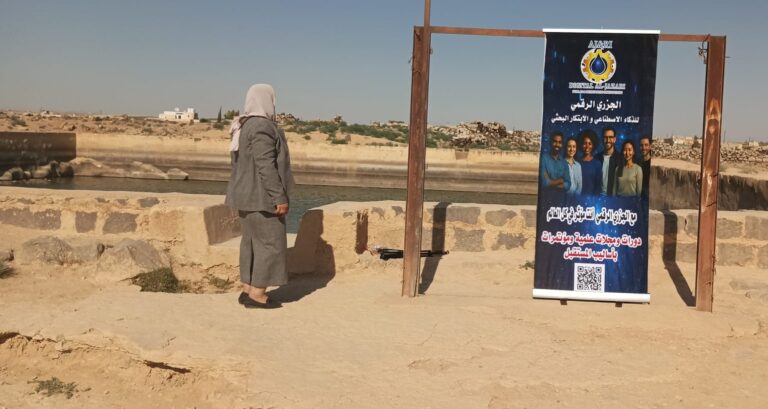
Umm al-Jimal: inspecting the historic water harvesting system
The Digital Al-Jazari team visited Umm al-Jimal to inspect its reservoirs, settling basins and water conveyance routes.
Stop one · Reading heritage
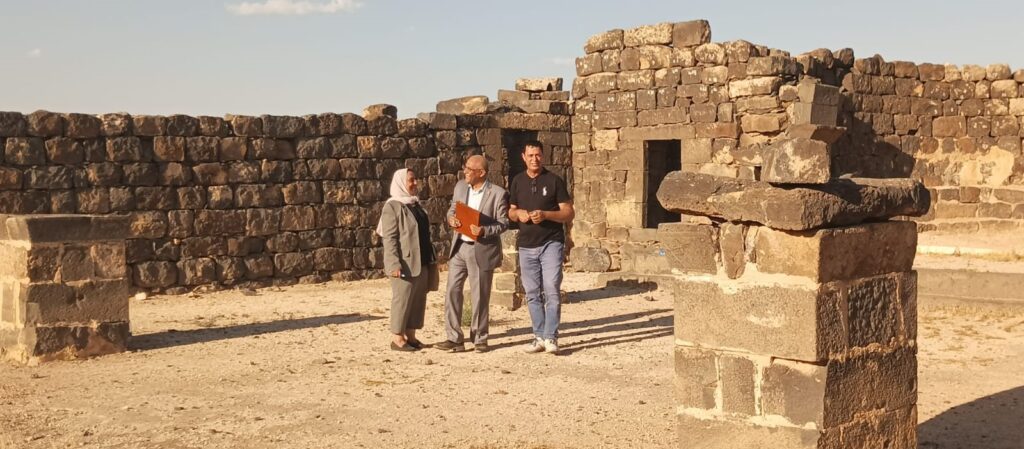
At Umm al-Jimal in northern Jordan, reservoirs and runoff channels tell how people lived with water scarcity. We read these structures to understand what their experience can offer today.
A visit among the basalt structures of Umm al-Jimal, as part of reading the water system and local knowledge. · Photo: Digital Al-Jazari archive
Umm al-Jimal is in Mafraq Governorate, northern Jordan, near the Syrian border: a historic town built of black basalt.
How was rainwater collected, conveyed and stored in a dry environment? And which principles can we understand today without copying the shape of the structures?
Umm al-Jimal had no river or permanent spring. Its people relied on collecting rainwater and directing it into reservoirs and pools, with basins that let silt settle before storage. This chain — collect, convey, settle, store, use — is what we try to read on site.
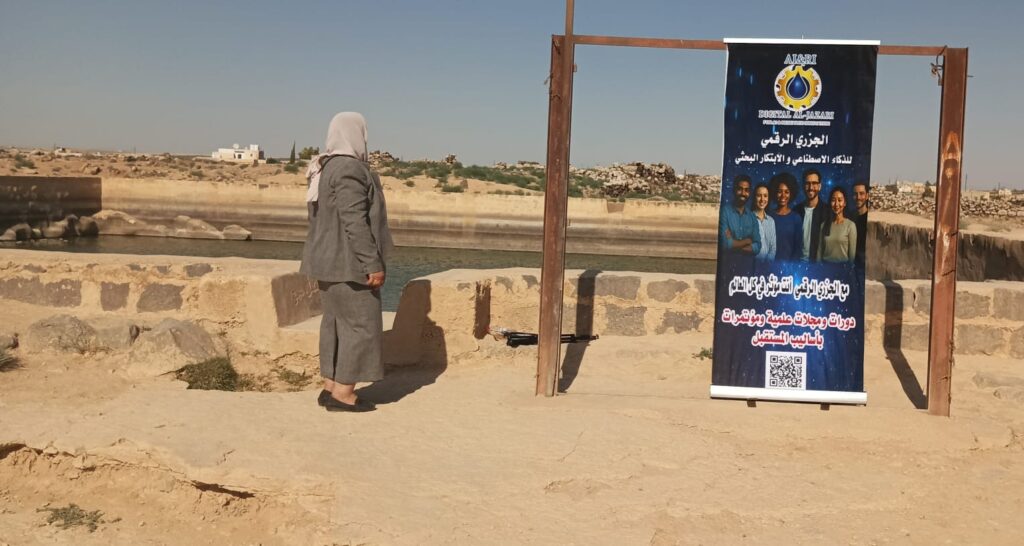
We do not rebuild Umm al-Jimal or replicate its remains. We document the structures and read their routes, then turn the principles into questions and calculations that can be checked. Any intervention at an archaeological site is not our work; our work is reading and learning.
Calculate how much rain a surface can collect, or open the interactive water-budget notebook on the Lab website.
Harvest calculator Umm al-Jimal water journey notebook — Digital Al-Jazari Lab (external link)
The Digital Al-Jazari team visited Umm al-Jimal to inspect its reservoirs, settling basins and water conveyance routes.
Your next step in our other work: learn, publish, experiment and take part.
Publish your research on water, climate and society in three peer-reviewed journals within one smart publishing system.
Self-paced courses and certificates, including AI and research skills.
The interactive tools behind our field projects, and how they are developed.