
Deir al-Kahf: assessing the pilot site and its runoff routes
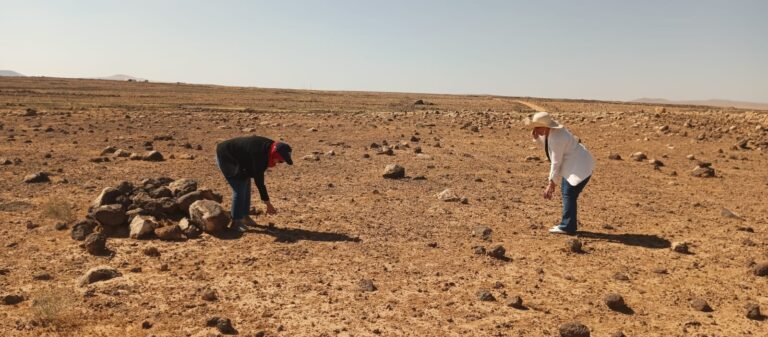
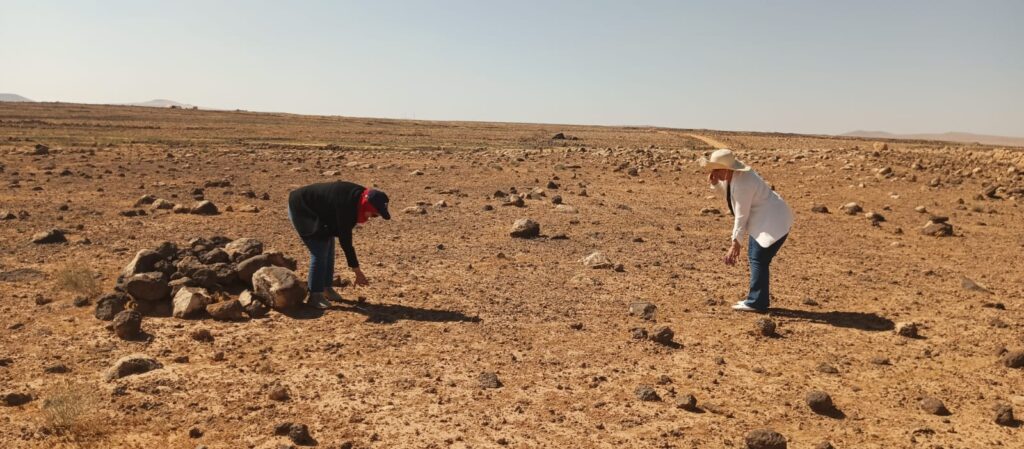
The team assessed the land, topography and rainwater runoff routes at the Deir al-Kahf pilot site.
Stop two · Testing the idea
In the northern Badia we are developing a pilot site for rainwater harvesting and support for the recovery of native vegetation. The trial is in development, and here we separate what has been done from what is proposed.
Field work at Deir al-Kahf, part of the track that studies local water knowledge. · Photo: Digital Al-Jazari archive
Deir al-Kahf lies in the northern Badia of Mafraq Governorate, east of Umm al-Jimal: dry, stony land that depends on scarce and irregular rain.
Can a simple water harvesting system, inspired by Umm al-Jimal's principles and adapted to the place, provide enough water to support native plants and limit land degradation?
These are proposed components, not yet built. They need measurements, expert review, permissions and partnership with the local community before implementation.
Harvested water gives native plants a chance to return, and plants in turn protect the soil from erosion and help it hold moisture. So we treat water harvesting and vegetation recovery as parts of one system.
There are no published measurements yet of water harvested or of vegetation improvement at Deir al-Kahf. We will publish each result when its data and method are available.
Compare collection and storage scenarios, or calculate how much rain a given area could collect.
Harvest calculator Deir al-Kahf adaptation and comparison lab — Digital Al-Jazari Lab (external link)
The team assessed the land, topography and rainwater runoff routes at the Deir al-Kahf pilot site.
Your next step in our other work: learn, publish, experiment and take part.
Publish your research on water, climate and society in three peer-reviewed journals within one smart publishing system.
Applications and tools that start from people's needs: checking answers, protecting data and measuring benefit.
The interactive tools behind our field projects, and how they are developed.